


Transforming Complex Data into Intuitive Digital Experiences
Discipline
Interface Design, Interaction Design, Product Thinking
Team
4 x UX Designers
2 x Developers
5 x Product Managers
Role
Interface UX Designer
Timeline
January - April 2024
Overview
My work included designing interaction flows for the Network Services Platform (NSP) module that enabled operators to troubleshoot networking issues quickly and efficiently. I also helped identify and present persistence issues to the UX team, developers, and Product Line Managers (PLMs) to enhance the platform’s usability. Additionally, I contributed to the design systems team by helping with their existing color guide. I worked on an Automation concept that employed data visualization techniques to present complex data effectively.
⚠️ This project is partially shipped, so this page does not reflect everything I worked on. If you're a hiring manager, please get in touch with me via email, and I would be happy to discuss my contributions in more detail :)
[Project 1]
Simplified Interaction Flow for Device Management
One of my primary tasks was to delve into an ongoing project centered on the Device Management module of Nokia’s Network Services Platform (NSP). NSP is a robust platform used by network operators, engineers, and developers to manage, monitor, and troubleshoot various network elements and services.
This module is crucial for operators who need to identify issues with network elements and troubleshoot services rapidly. My primary contribution involved designing a streamlined interaction flow that enabled operators to compare and troubleshoot network elements more efficiently. I brainstormed and developed a more intuitive approach to triggering these interactions, replacing the existing process with a solution that reduced the number of clicks and simplified the user experience.
Use Case:
Operators are unaware of the specific issue but are aware that one network element is functioning correctly, while the other is not.
There are over 50 network elements of different product types in a list, but only those of the same type can be compared.
Pain Points:

Design Iterations:


These iterations reflect ongoing feedback, including:
Allow operators to go back if a wrong network element (NE) is selected.
Reduce the number of dialogs to save steps.
Ensure data is not fetched and displayed twice.
Keep selections visible on the screen at all times for easy reference.
Final Iteration:
I incorporated this feedback into my designs and presented the following flow.
It received a positive response from the UX team and developers, and went into the implementation stage! :)


A modal bottom sheet so operators can go to the main screen by clicking on the close icon.
These were notes for the developers!
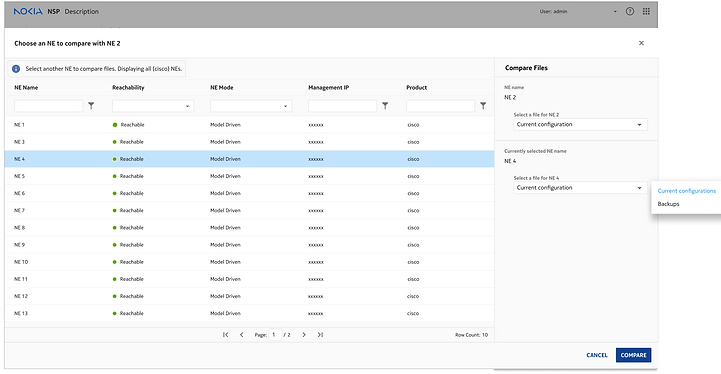
The inline notification shows the product type and all NEs displayed are automatically filtered.
Operators can see the selected NE and choose which configuration they want to compare, all in one modal.

[Project 2 & Project 3]


I co-led a persistence project, primarily focusing on reviewing all NSP modules and screen recording persistence issues. Additionally, I created low to mid-fidelity mockups illustrating the recommended behavior. I compiled everything into a specification that developers can utilize to write tests and automate the QA process for NSP.
These are examples of some of the components that I worked on, which were documented in a spec. I co-presented the spec to a group of 18, which included UX designers, developers, and a product manager.
All good things must come to an end so that better things can come!
I'm incredibly grateful for this internship, as it pushed me to grow both as a designer and a team member. I learned a lot about Networking Services and designing with limited technical knowledge. Prototyping early helped me communicate ideas effectively and demonstrated proactiveness. Collaborating with cross-functional teams taught me that design critiques aren't personal but are essential for the project's success and the users' benefit.


